
Communication Training for Global Founding Teams
Your team is brilliant, but not all of it comes through in a second language.
You already know your CTO can build it. You've watched them do it.
What you haven't figured out is why they go quiet the second a client asks a question that isn't quite the one they rehearsed for. Or why your Head of Sales describes what you do differently depending on who's asking, not adapting the pitch to the audience (that part's smart), but actually contradicting the last version: a different number, a different customer story, a different answer to "so what does this actually do." Or why the copy your marketing lead writes makes total sense to everyone on your team and lands flat with everyone outside it.
None of that is a skills gap. Your people are good at their jobs. It's a communication gap, and it shows up exactly when you can least afford it: in front of a client, in a team meeting where nobody's sure who owns what, in the moment a new hire asks "wait, so what do we actually do?" and gets three different answers from three different people.
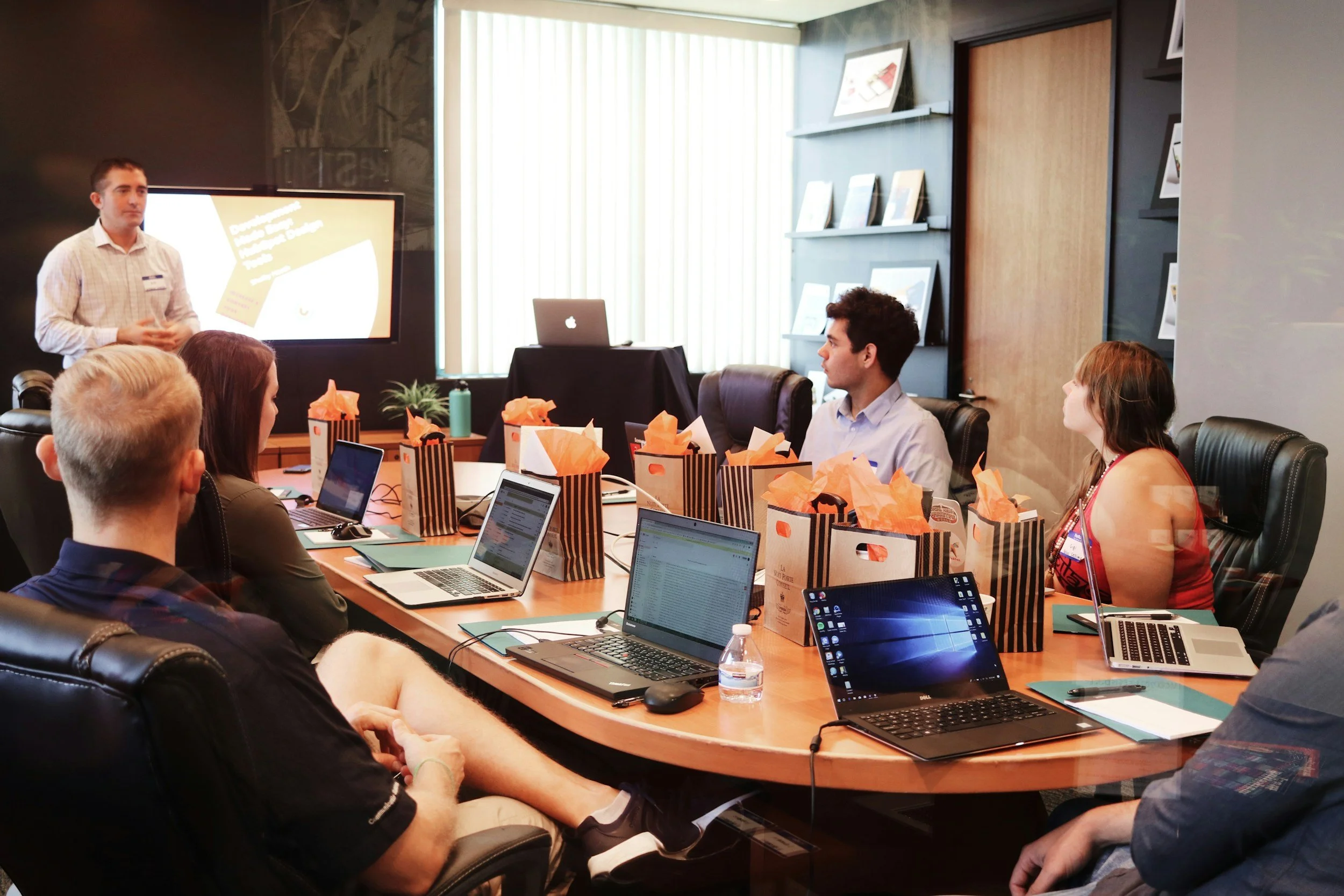
Why This Happens at Startups Specifically
In the early days, your team is small and everyone is doing what they're best at. Your CTO builds. Your Head of Sales sells. You run the company. Nobody had time to get on the same page about how to talk about the business, because you were all too busy building it.
Then you grow. You hire. And there's no L&D department to onboard those new hires into a shared way of communicating, so whoever's already there trains them the only way they know how: by example, on the fly, in whatever style they personally default to. Three hires later, your company has four different versions of "what we do," and nobody assigned it that way. It just happened.
Add in the people who are genuinely excellent at the technical side of the business. They've spent years deep in the architecture, the code, the mechanics of how things actually work. Standing in front of a client and being the face of the company was never the job they signed up for, and it shows the moment a conversation gets less technical and more human.
And the person at the top: your CEO might love pitching, or love the business, or both. What they usually haven't done before is lead a team, hold everyone to one shared way of talking about the company, and manage the version of that story that shows up every time someone new joins. First-time founders are often first-time leaders too, learning how to hold a team together at the same time they're learning how to run the company.
None of this is a hiring mistake. It's what happens when a company grows faster than its internal training can keep up with. It's fixable, but only if someone actually builds the training, because right now nobody has.
What's Actually Happening
Your CTO explains how the product works instead of what it does for the customer. Technically accurate, completely useless to a client who didn't build it and just wants to know if it solves their problem.
Your CEO can tell the founding story flawlessly one-on-one, then loses the thread the second a room full of people, a panel, a new hire's first week, anyone who isn't already sold, asks a follow-up they didn't expect.
Your Head of Sales, your CS lead, and your CEO each describe the product slightly differently. Not tailored to the audience, actually inconsistent: different numbers, different framing of what problem you solve, different answers to the same basic question. Customers notice. New hires get confused about what they're even supposed to say.
And if someone on your leadership team is operating in a second language, in front of clients or investors who decide whether to trust you in the first two minutes, all of this gets harder. Not because their English is weak, but because directness that reads as confidence in Portuguese reads as abrupt in English, and formality that reads as respect in one culture reads as distance in another. Nobody taught them the difference. Nobody was going to, because there's no one on staff whose job that is.
This is the layer most corporate training skips entirely. It's also the one costing you the most: the client who went quiet after a great first call, the new hire who took three weeks to figure out what your company actually does, the team meeting where everyone nodded and nobody was actually aligned.
Why I Can See It and Most Coaches Can't
I've spent twenty years working at exactly this gap: teaching in classrooms in South Korea and Thailand, running federally funded language programs in Calgary, and coaching non-native English speaking founders and their teams.
I'm not fixing accents. I'm not teaching grammar. I can hear the exact moment someone's phrasing works against them, whether it's a leader translating in real time mid-sentence or a CTO who's technically fluent but has never been taught how to talk to someone outside the codebase. And because you don't have an internal L&D team building this for you, I build it with you, from scratch, around what your team is actually up against.
What We Work On
Every program is built around your team's actual gaps, not a generic curriculum. Depending on where things are breaking down, we work on:
Getting everyone telling the same story. Right now your CEO, CTO, and Head of Sales are each describing the business slightly differently. Clients notice before you do, and so does every new hire trying to figure out what to say. We build one shared narrative and make sure everyone can deliver their piece of it, consistently, under pressure.
Turning technical knowledge into language that lands. Your team knows more than they're able to say simply. We fix the gap between what they know and what a client, a new hire, or a partner actually hears, especially for the people who are more comfortable in the architecture than in the room.
Building the physical layer nobody trains. Voice, pacing, how to hold a room in the first ten seconds, what to do with silence instead of filling it. Most communication training never touches this. It's usually the difference between a client who leans in and one who checks out.
Making a second language stop being the thing people notice. For leaders operating in English as a second language, we work at the level of pacing, register, and idiom, not grammar drills, so what they say lands the way they actually mean it.
How It Works
We start with a conversation about what's coming up and where the real gaps are. From there, I build a program around your team's timeline and goals, not a template.
Format options:
Half-day or full-day workshops for your leadership team or full company
Cohort programs over 4–8 weeks with group sessions and 1:1 coaching
Pre-event intensives before a fundraise, demo day, product launch, or conference
Monthly retainer for teams in active fundraising or high-growth phases
Available in-person in Calgary or remotely worldwide.
Email hello@jennkrentz.com to talk about what your team is actually up against.
Also offering: Deliver Your Deck 1:1 Coaching for individual founders or co-founders pitching together and Services & Audits for async feedback
Questions Founders Ask
-
Deliver Your Deck is 1:1 coaching for a single founder building an investor pitch. Team Cohort is for co-founders building one shared pitch together. This is for a broader leadership team, not just the founders, working on how you communicate day to day: with clients, with new hires, with each other. It's less about one pitch and more about how your whole company talks about itself.
-
It's built for growing teams specifically, the stage where you've hired past the founders but don't have anyone whose job it is to train people on communication. If you have an internal L&D function already, you don't need this. If you don't, and you're starting to feel the gap, this is exactly the stage it's built for.
-
No. Most of what we work on is client-facing and internal, not investor-facing. If you're heading into a raise, we can build the program around that timeline, but plenty of teams do this work with no fundraise in sight.
-
That's normal. We start with a conversation about where the actual gaps are and build the program around your team, not a fixed curriculum. Some engagements are one person who needs the most work, others are the whole leadership team getting aligned together.
-
No. The cross-cultural and second-language work is one part of what I do, and it's a part most coaches can't touch, but plenty of teams come to me with zero language barrier and a straightforward alignment and delivery problem. Both are welcome.
-
Depends on what you need. A half-day workshop can shift a specific gap before a big moment. A 4–8 week cohort builds something that sticks. A monthly retainer works for teams that are actively growing or fundraising and need ongoing support. We figure out the right format on a discovery call.
-
Both. In-person in Calgary, remote everywhere else.
-
It depends on the format and size of your team, so I don't post a flat price. Please email me at hello@jennkrentz.com to discuss your companies needs.